Planning a trip to the Netherlands often begins with one practical question, where should you stay to see as much as possible without constantly changing hotels. Many visitors assume Amsterdam is the only logical option, yet the country is far more compact and interconnected than most American travelers expect. Choosing a Central Netherlands travel base can make it possible to experience historic canals, modern architecture, tulip fields, and national parks while sleeping in the same place each night. Because distances are short and trains run frequently, the Netherlands functions more like a single metropolitan region than a large country. Understanding how geography works here is the key to building an efficient and relaxed itinerary.
Understanding Central Netherlands as a Travel Hub
What “Central” Really Means in the Netherlands
The Netherlands is roughly the size of Maryland, with a population concentrated in the western urban ring known as the Randstad. This area includes Amsterdam, Rotterdam, The Hague, and Utrecht. Utrecht sits near the geographic center of this ring and functions as the country’s main rail junction. From here, nearly every major city is within about an hour by train.
For American travelers used to long interstate drives, this scale can be surprising. Traveling from Amsterdam to Rotterdam takes about the same time as commuting between suburbs and downtown in many US cities. Because of this, a centrally located base allows you to move easily between regions without repacking.
The Advantage Over Staying Only in Amsterdam
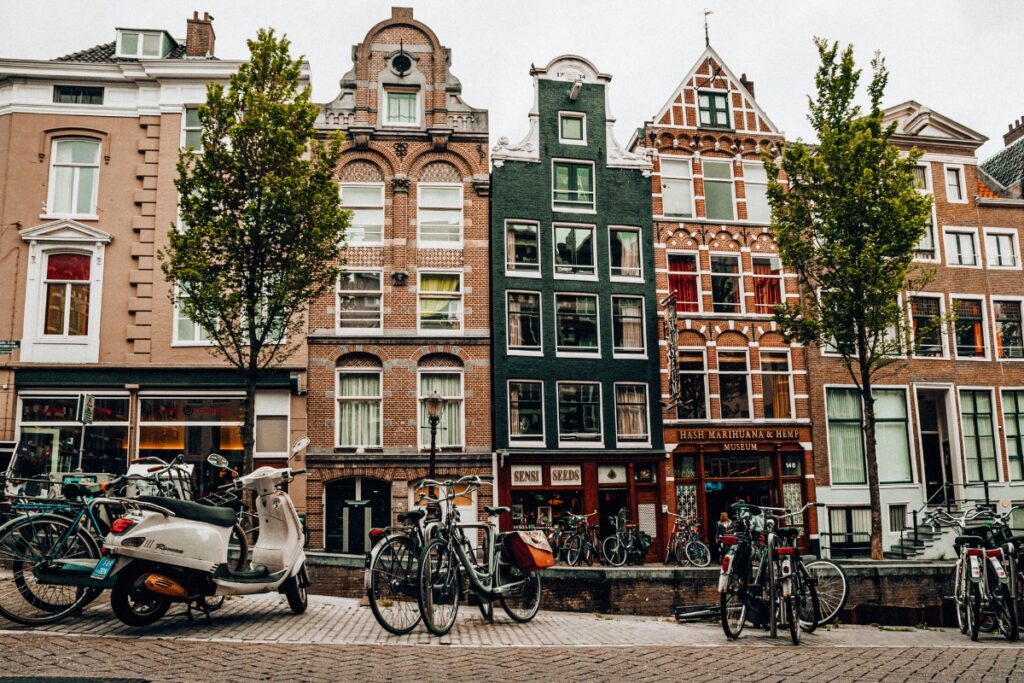
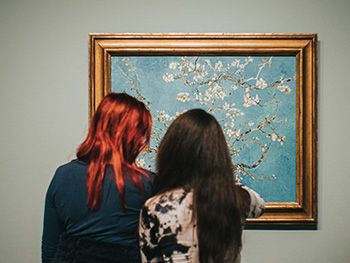
Amsterdam offers world famous attractions such as the Rijksmuseum, the Van Gogh Museum, the Anne Frank House, and the canals that define its historic core. However, it is also the most crowded part of the country. A more central base, for example near Utrecht or in the surrounding countryside, offers direct rail access to Amsterdam while also placing you closer to Rotterdam, The Hague, and eastern nature areas.
Instead of commuting outward from one corner of the country, you are positioned in the middle of the network. This reduces travel time overall and spreads your experiences across different regions of Holland and the broader Netherlands.
Day Trips Made Easy from the Center
Amsterdam and Haarlem
From a central base, Amsterdam is typically 20 to 40 minutes away by train. You can spend a full day exploring its canals, Vondelpark, Oude Kerk, and museum district, then return to quieter surroundings in the evening. Haarlem, just west of Amsterdam, offers a smaller scale historic center with charming streets and access to nearby beaches.
Zaanse Schans, known for its traditional windmills, is also easily reached from Amsterdam and fits naturally into a day trip plan.
Rotterdam and The Hague
Heading south places you in Rotterdam city in under an hour. Rotterdam presents a striking contrast to Amsterdam. Its skyline features modern architecture such as the Cube Houses, Erasmusbrug, and the Markthal. The city’s maritime identity is visible along the Nieuwe Waterweg and in its port areas, often referred to as the Rotterdam World Port.
The Rotterdam Metro and tramway network make it easy to move between neighborhoods such as Kralingen and the city center. The Hague, the seat of government, lies just beyond and offers elegant boulevards and cultural institutions. Delft, between the two, is closely associated with Johannes Vermeer and the Vermeer Centrum Delft, providing a smaller historic setting with canals and brick facades.
Leiden, Gouda, and Smaller Historic Towns
Leiden combines university culture with compact canals and museums. Gouda is known for Gouda cheese and its traditional cheese markets, which illustrate centuries old trade practices. Muiden and Naarden offer fortified towns with preserved defensive walls that reveal another layer of Dutch history.
Because train distances are short, these towns can be visited without long travel days. You might explore Leiden in the morning and enjoy dinner back at your base the same evening.
Access to Nature and Open Landscapes
National Parks and the Veluwe
A central location does not only connect cities. It also opens access to natural areas such as De Hoge Veluwe National Park and Veluwezoom. These landscapes feature forests, heathlands, and cycling paths. The Kröller-Müller Museum inside De Hoge Veluwe National Park houses a notable Van Gogh collection in a quiet, natural setting.
For travelers who want balance, combining urban museums with open countryside is straightforward from the middle of the country.
Tulip Fields and Keukenhof Gardens
In spring, Keukenhof Gardens and surrounding tulip fields attract visitors from around the world. These flower parks are located between Amsterdam and The Hague, making them especially convenient from a central base. Instead of relocating closer to the coast, you can take a direct train and short bus ride, then return the same day.
The same applies to other water oriented destinations such as Giethoorn, known for its canals and small boats, and Vinkeveen, popular for watersport activities.
Transportation Without a Car
Rail as the Backbone
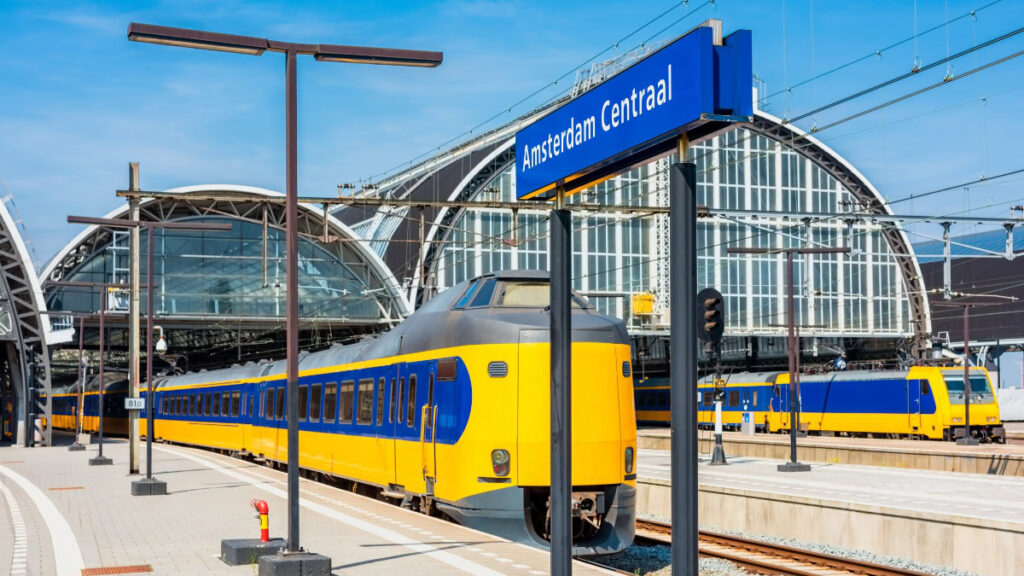
The Dutch rail system is dense and reliable. Utrecht serves as the primary interchange, meaning most routes connect there. From a central base near this hub, you can reach Amsterdam, Rotterdam, Leiden, or Zwolle quickly and frequently.
This setup resembles staying near a major airport hub in the United States, except here the connections are by train and often depart several times per hour.
Urban Networks in Major Cities
Once in Rotterdam, the Rotterdam Metro and tramway network provide seamless connections across the metropolitan area. In Amsterdam, trams link the historic center with residential districts and museums. Even in smaller cities like Delft or Gouda, the main attractions are within walking distance of the train station.
Because distances are short and infrastructure is designed for public transport and cycling, renting a car is usually unnecessary when based centrally.
Where a Countryside Base Fits In
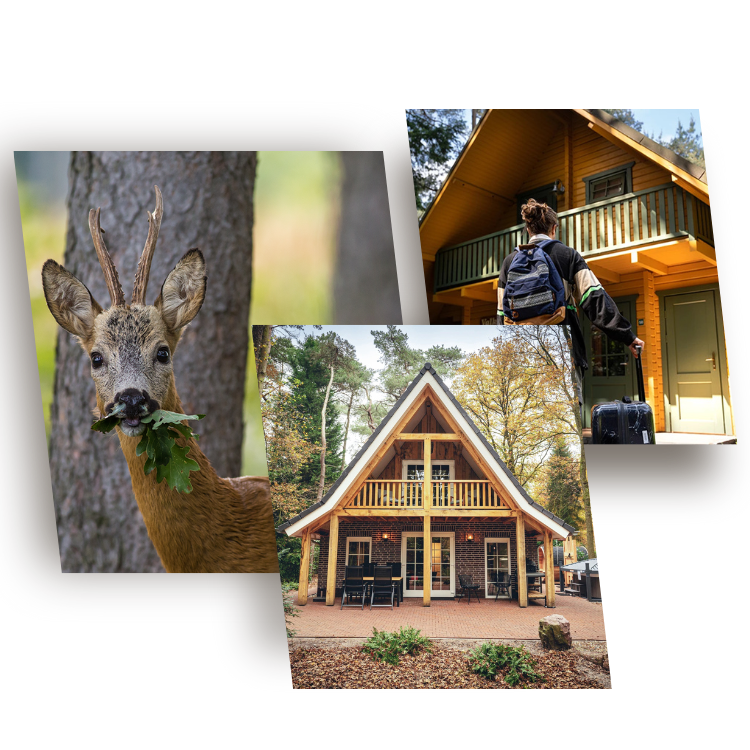
A countryside accommodation in the middle of the country offers a different atmosphere than city hotels. Locations near forests or small villages allow you to return to quiet evenings after full days in busy urban centers.
For example, bungalow parks such as ’t Eekhoornnest are situated in a way that provides access to Utrecht, Amsterdam, and Rotterdam while also bordering natural landscapes. In this context, the base supports the travel strategy rather than dominating it. The primary benefit is geographic balance, not luxury or amenities.
This approach works especially well for families or travelers who prefer space and calm surroundings but still want daily access to major cultural attractions.
Comparing the Experience to US Travel Patterns
In the United States, visiting multiple major cities often requires flights or long highway drives. In the Netherlands, Amsterdam, Rotterdam, The Hague, and Utrecht function almost like boroughs of one extended region. The scale is closer to traveling between Washington, DC and Baltimore than crossing entire states.
Because of this, the concept of a central base is more practical here than in many larger countries. Instead of treating each city as a separate stop, you can treat them as connected neighborhoods within a compact national landscape.
Conclusion
Using a central base in the Netherlands allows travelers to combine canals in Amsterdam, modern architecture in Rotterdam, political history in The Hague, university culture in Leiden, and open landscapes in De Hoge Veluwe National Park without changing accommodation. Short rail distances and frequent connections make day trips simple and predictable. For visitors from the United States and Canada, understanding the country’s compact geography changes how an itinerary is built. Rather than planning a series of hotel transfers, one well chosen location can anchor the entire trip. Center of Holland provides guidance on how these regions connect, helping travelers understand the structure behind the scenery.
The clearest example is Soest, in the province of Utrecht. It sits close to the geographic center of the country, with Amsterdam about 38 minutes away by car and Utrecht around 20.