Tulip season is not a fixed date range, but rather a period influenced by temperature, rainfall, and soil conditions. In general, the season begins in late March and continues into early May, with April being the most reliable time for seeing full bloom. This window can shift slightly each year, which is why many travelers monitor forecasts or plan within a flexible range.
The blooming process follows a natural progression. Early in the season, you will see crocus and daffodil fields, followed by hyacinths, and finally tulips reaching their peak. This layered development means that even outside the peak tulip weeks, there is still a visible flower landscape. For travelers, this also means that visiting too early may result in fewer tulips, while visiting too late may mean that some fields have already been cut for bulb production.
Because of this, mid April is often considered the most balanced moment, with both the variety and density of colors at their highest. However, this is also when visitor numbers increase, especially around well known locations.
Where to see tulips in the Netherlands
Many travelers associate tulips primarily with Amsterdam, but the fields themselves are located in several regions across the country. Each area offers a slightly different experience, depending on scale, accessibility, and level of tourism.
Keukenhof and the Bollenstreek
The Bollenstreek, or Bulb Region, is the most well known area for tulip viewing. Located between Amsterdam and The Hague, it includes towns such as Lisse and Haarlem. Within this region, Keukenhof Gardens provides a curated experience where flowers are arranged in designed landscapes, allowing visitors to walk directly through displays of tulips, hyacinths, and other spring flowers.
This is often the most accessible option, especially for first time visitors. The surrounding countryside also contains large flower fields, which can be explored by bike or car. The combination of structured gardens and open landscapes makes this region the most complete introduction to tulip season.
Flevoland and Noordoostpolder
For those looking for a quieter and more expansive experience, Flevoland and Noordoostpolder offer a different perspective. These regions are less focused on tourism and more on large scale agriculture, which results in longer stretches of uninterrupted tulip fields.
Here, the landscape feels more open and less curated. Instead of concentrated visitor areas, you move through wide polder landscapes where fields appear as part of the natural environment. This creates a more relaxed experience, especially for travelers who prefer fewer crowds and more freedom in how they explore.
North Holland and surrounding areas
In North Holland, including areas closer to the North Sea and regions such as Kop van Noord-Holland, tulip fields are also present but more spread out. These areas are often combined with coastal visits or smaller towns, offering a more varied itinerary.
Tulip fields versus curated gardens
A common misunderstanding is that all tulip locations offer the same experience. In reality, there is a clear difference between agricultural fields and curated gardens, and understanding this helps set realistic expectations.
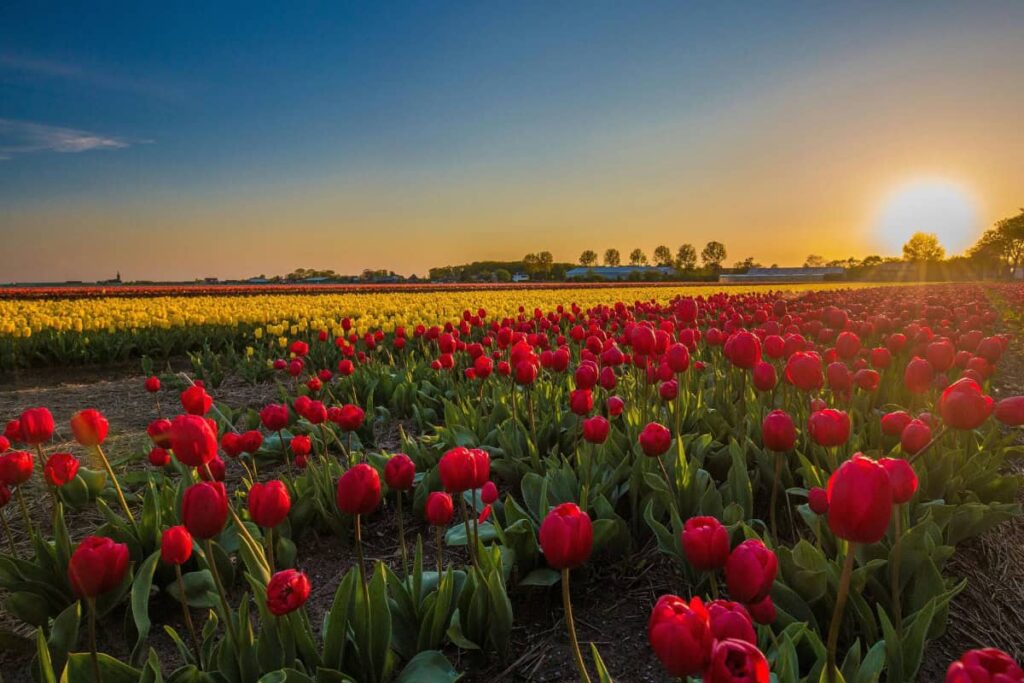
Tulip fields are working farmland where flowers are grown for bulb production. They are not designed for visitors, and in most cases you are expected to view them from the roadside or nearby paths. This means you experience the scale and color from a distance, which can still be visually impressive, especially during golden hour when light conditions enhance the landscape.
Curated spaces such as Keukenhof Gardens, Tulip Experience, or The Tulip Barn are designed specifically for visitors. These locations allow closer interaction with the flowers, often including walking paths, indoor displays, and educational elements about tulip cultivation. While they may feel more structured, they provide access that is not possible in regular fields.
How to get around during tulip season
One of the advantages of tulip season in the Netherlands is how accessible the different regions are. The public transport network connects major cities with tulip areas efficiently, allowing travelers to move between locations without relying entirely on a car.
From Amsterdam, trains connect to cities such as Haarlem and Leiden, where local buses or short bike rides lead to the surrounding fields. Planning tools like 9292.nl simplify this process by combining train and bus routes into a single journey overview. For many visitors, this combination of transport modes is both practical and easy to navigate.
Cycling plays a central role in how tulip regions are experienced. Bike routes through the Bollenstreek and Flevoland allow you to move slowly through the landscape, stopping where views are most interesting. This approach differs from typical road trips in the United States, where distances are larger and stops are less frequent. In the Netherlands, cycling becomes part of the experience rather than just a means of transport.
Driving is another option, especially when visiting multiple regions in one day. The road network is well maintained and distances are short, making it possible to combine locations such as Lisse and Flevoland within a single itinerary. However, during peak season, traffic and parking near popular areas can become more challenging.
Combining tulips with other destinations
Tulip season does not need to be a standalone activity. Because the Netherlands is compact, it is easy to combine flower viewing with cultural and urban experiences.
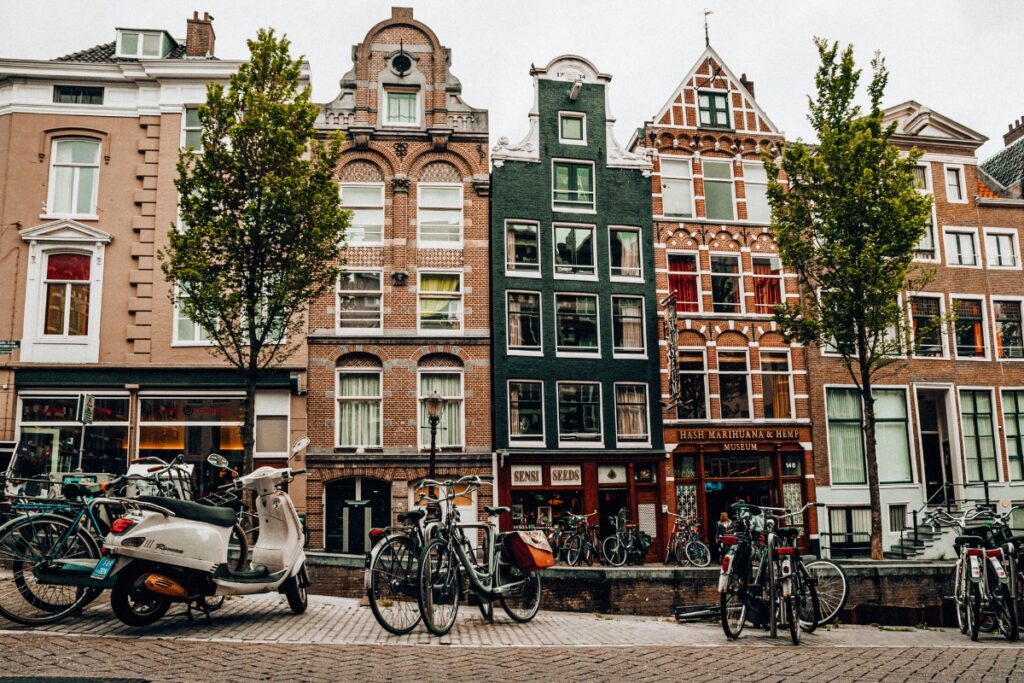
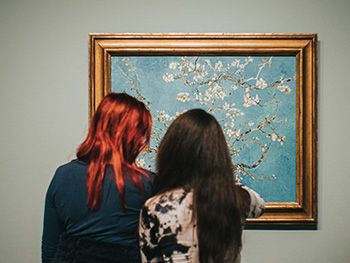
From the Bollenstreek, Amsterdam is within reach, offering access to museums such as the Rijksmuseum or locations like the canal belt and Anne Frank House. Coastal areas near the North Sea can also be visited on the same day, adding variation to the itinerary.
A practical approach is to stay in a central location and plan day trips in different directions. From central Holland, cities like Utrecht, Amsterdam, and The Hague are all within a relatively short journey time. This reduces the need to change accommodation while still allowing access to multiple tulip regions.
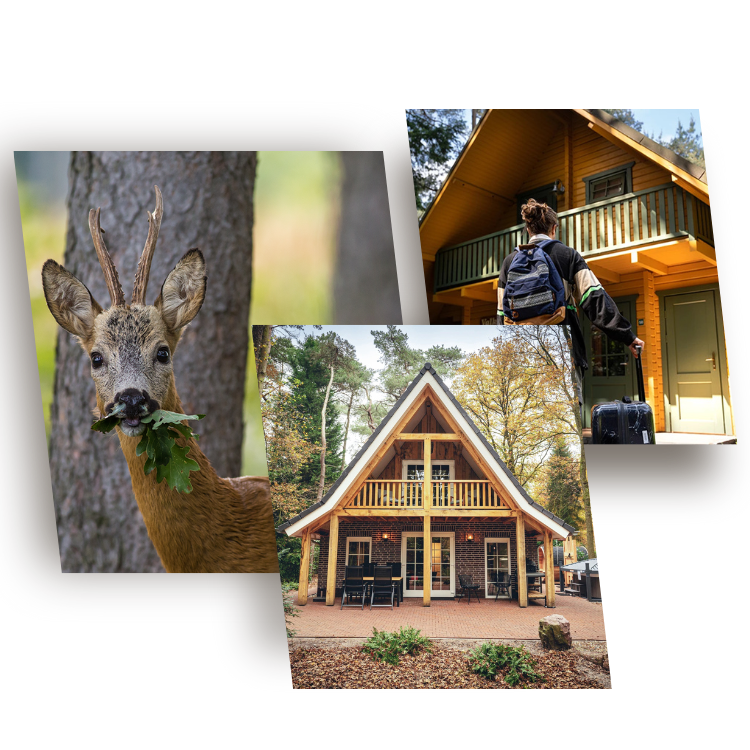
A location such as ’t Eekhoornnest Holiday Village fits into this type of travel structure. It provides a base from which you can reach both the Bollenstreek and more northern or eastern regions, while also being close to major transport connections. This makes it easier to plan flexible routes depending on weather and bloom conditions.
Practical considerations for visiting tulip season
Timing your visit within the day can influence your experience as much as the overall travel period. Early mornings and late afternoons offer softer light, often referred to as golden hour, which enhances the colors of the fields and creates better conditions for photography.
Spring weather in the Netherlands can change quickly. Temperatures may vary throughout the day, and light rain is not uncommon. Layered clothing is often more practical than relying on a single type of outfit.
It is also important to recognize that tulip fields are part of an agricultural system. Respecting boundaries and staying on designated paths helps preserve the fields for both farmers and future visitors. This balance between tourism and production is a key part of how tulip season functions in the Netherlands.
Conclusion
Tulip season in the Netherlands offers a combination of natural landscapes, cultural context, and accessible travel. While the exact timing depends on weather conditions, the overall period provides a reliable window for experiencing one of the country’s most recognizable features.
By understanding the differences between regions, the role of curated gardens, and the structure of the transport network, visitors can plan a trip that goes beyond a single location. The compact nature of the country allows tulip viewing to be combined with cities, museums, and coastal areas without complex logistics.
Center of Holland helps travelers navigate these choices by providing practical guidance and context, making it easier to experience tulip season as part of a broader journey through the Netherlands.