It rains in the Netherlands about 130 days a year, and the summer high is a modest 22°C. So the Dutch built themselves an indoor tropics.
The subtropisch zwembad, or subtropical swimming paradise, is a national institution: a vast heated hall kept above 30°C year-round, full of palm trees, wave pools, lazy rivers and slides, where it is permanently July regardless of what is happening outside. There is no real American equivalent. There is barely a European one. The Netherlands has dozens.
This is what they are, which ones are worth the trip, and the rules and ticketing traps that catch out every first-time visitor.
What a Subtropical Swimming Paradise Actually Is
It is an indoor water park kept at tropical temperature, built specifically to defeat the Dutch climate.
The formula dates to the 1980s and has barely changed, because it works. A glass hall, real palms, water at 30°C or above, a wave pool, a lazy river, a toddler area with a shallow heated pool, and a bank of slides ranging from gentle family tubes to pitch-dark funnels. Many have an outdoor section that opens in summer.
The critical thing to understand is that most of them are attached to holiday parks, not standalone. Center Parcs built its entire business model on the Aqua Mundo. Landal, Roompot and EuroParcs parks have their own versions. That means access rules vary enormously: some sell day tickets to the public, some are guests-only, and some let you in for a limited window per day. Our guide to family resorts and holiday parks covers how the parks themselves work.
Tikibad at Duinrell: The Biggest
21 slides, the largest water park in the Benelux, and the one to pick if you only do one.
The Tikibad, branded the Tiki Pool in English, sits at Duinrell in Wassenaar, in the dunes between Scheveningen and Katwijk, about 20 minutes from The Hague. The water never drops below 30°C.
The slide list is the point. The Moonlight and Starfright send you down in a boat through dark tunnels lit with effects. Blits and Flits are twin racers. The Tyfoon has a free-fall section, the Cycloon and Triton are the fast ones, and there is a family slide you can ride together. Playa is the separate indoor area for toddlers and small children, with four gentle slides and a heated play pool for under-4s. Outside there is a heated pool, a water playground and the largest tipping bucket in the Netherlands, which dumps around 1,700 litres on whoever is standing underneath.
The ticketing trap, and this one is expensive. If the Duinrell amusement park is open, you cannot buy a Tikibad-only ticket between 10:00 and 16:00. In that window you must buy a combination ticket covering both, which runs from around €29.50 per person instead of roughly €19.50 for the pool alone. Turn up at 11am wanting only the water park and you will pay for a theme park you did not plan to visit. The workaround: go in the evening. The Tikibad stays open until 21:30 and the pool-only ticket applies from 16:00.
Two more things: tickets are online-only, and parking is a separate €15.
Aqua Mundo: The Center Parcs Pools
Some Aqua Mundos sell day tickets. Not all of them. Check before you drive.
Aqua Mundo is Center Parcs’ brand for its subtropical pools, and they are the reason a large share of Dutch families book Center Parcs at all. Each park’s version differs.
The most interesting for day visitors is Center Parcs De Eemhof in Zeewolde, on the Flevoland lakeshore, which does sell online day tickets. It has five slides including the Turbo Twister, a wave pool, the fastest wild-water rapids in the Center Parcs group, a diving pool with lessons, and a Flow Rider artificial surf wave, which is genuinely rare in the Netherlands. In summer there is a lake, a beach and watersports outside.
The general pattern across the chain: staying at the park always includes unlimited pool access, day visits are sometimes possible and sometimes not, and the pool is busiest in the two hours after lunch on a wet day.
The Outdoor Ones
Two genuinely good options, and both are summer-only.
Waterspeelpark Splesj near Hoeven, between Breda and Roosendaal, is the country’s best outdoor water park: seven slides, a water garden and Turtle Island for small children, and a 900m² spray park that claims to be the largest in Europe. Entry is free if you are staying at the neighbouring Molecaten park.
Fun Beach in Limburg is a different animal: an inflatable obstacle course floating on a lake, with a separate Little Beach area for under-12s and cabanas for adults who would rather not.
Both are excellent in July and shut when the weather turns, which is exactly when you want a water park. Plan accordingly.
The Rules Nobody Tells You
Dutch pools enforce height and weight limits, and they do not negotiate.
At the Tikibad, if you are under 1.50m or over 100kg you are barred from several slides, and the dark tube slides have a 120cm minimum. Children under 12 must be accompanied by an adult in the water. Every park publishes its own list and staff check at the top of the stairs. Reading the safety rules before you drive two hours is worth doing, particularly if you have a child hovering near a height line.
The other thing to know: the Netherlands takes swimming ability seriously. Dutch children earn a formal swimming diploma (zwemdiploma A, then B and C) at primary school age, because this is a country made largely of water. Some pools ask about diplomas for unsupervised children. As a visitor you will not have one, which is fine, but it means staying with your children in the water rather than sending them off.
Bring: a €1 or €2 coin for lockers at most parks, flip-flops, and a towel each. Very few Dutch pools include towels.
When to Go
A wet weekday in autumn or winter is the best a Dutch water park ever gets.
This is the inverse of every other attraction in this guide. Summer is when the outdoor pools open and the indoor halls fill with everyone who was rained out of the beach. October to March is when they are cheap, uncrowded and, frankly, at their most appealing: 30°C and palm trees while it is four degrees and horizontal drizzle outside has an absurd charm that does not survive translation.
Avoid Dutch school holidays entirely if you have a choice. Krokusvakantie in February and the summer break are the two peaks. Our guide to the best time to visit the Netherlands has the calendar.
Where to Base Yourself
The honest answer: you probably do not need to build a trip around this.
If you are visiting the Netherlands from abroad, a water park is a rainy-afternoon rescue, not a reason to come. Treat it as insurance. The mistake is booking a park with a giant Aqua Mundo and then discovering you have paid a premium all week for a facility you used twice, which is the trade-off our family resorts guide goes into properly.
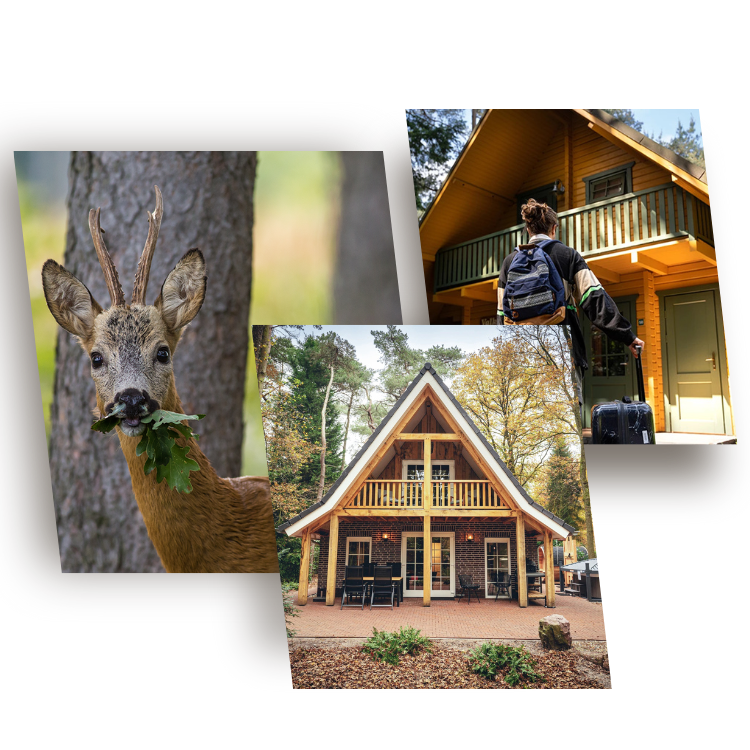
What you actually want is a base within easy reach of one, so you can decide on the morning it rains. From the middle of the country around the Utrechtse Heuvelrug, De Eemhof is about 45 minutes, Duinrell is about an hour, and Amsterdam is 30 minutes when the sun comes back out. Somewhere like Bungalowpark ‘t Eekhoornnest in Soest is a fair example of the shape: forest, a playground and a sauna rather than a water park of its own, with the big pools an easy drive away on the days you want them and nothing on the bill for them on the days you do not.
For the rest of the wet-weather list, Amsterdam with kids covers the indoor options in the city, and the family activities guide has the rest of the country. The Netherlands train map has travel times, though for water parks specifically a car is easier: most sit outside town, and you will be carrying wet towels.