
Netherlands Train Map
The Netherlands is the size of Maryland with the rail network of a much larger country. Almost every town worth visiting has a station, trains run every fifteen or thirty minutes without a timetable to memorise, and nothing is more than about two and a half hours from anything else.
That single fact reshapes how you should plan a trip here. This page is the map, the train types, the real travel times, and how to read all of it.
The Network at a Glance
The Dutch rail network is a dense mesh rather than a hub-and-spoke system. There is no single centre that everything passes through. Instead, four major junctions carry most traffic:
- Utrecht Centraal, the busiest station in the country and the closest thing to a national crossroads. Almost every long-distance journey touches it.
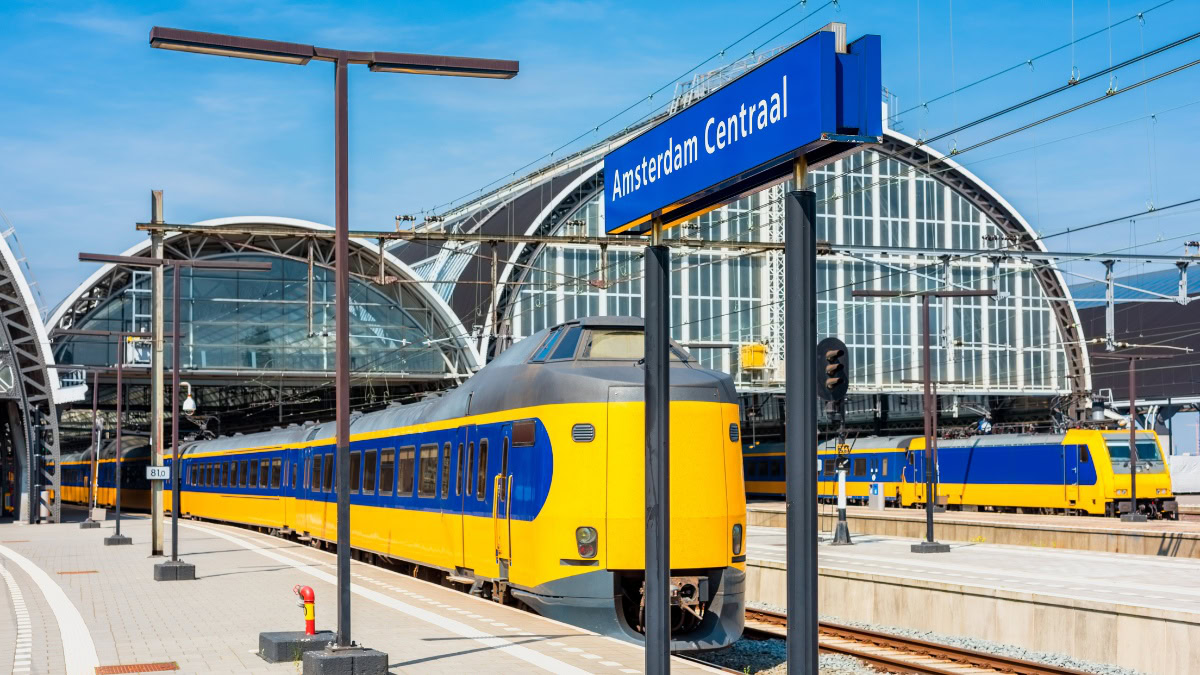
- Amsterdam Centraal, the terminus most visitors arrive at, and a dead end geographically. It sits at the top of the country, not the middle.
- Rotterdam Centraal, the southern gateway and the start of the high-speed line.
- Schiphol Airport, a full station under the terminal with direct trains across the country.
Behind them sit secondary junctions that matter more than their size suggests: Amersfoort for everything heading east and north, Zwolle for the north, Arnhem and Nijmegen for the east, ‘s-Hertogenbosch and Eindhoven for the south.
The infrastructure is owned by ProRail. Passenger services are run mostly by NS (Nederlandse Spoorwegen), with Arriva and a few regional operators on quieter branch lines. As a visitor you can ignore that distinction almost entirely.
Intercity or Sprinter
Two train types, and the difference matters.
Intercity (IC) trains stop only at major stations. This is the one you want for almost every journey over 20 minutes.
Sprinter (SPR) trains stop everywhere. Useful for small towns, painfully slow for long distances.
Intercity Direct runs on the HSL-Zuid high-speed line between Amsterdam, Schiphol, Rotterdam and Breda. It is faster and carries a small supplement on some sections. Note that it is high-speed track, not a high-speed train experience: the distances are too short for it to matter much.
The practical rule: if an Intercity and a Sprinter both serve your destination, take the Intercity and do not think about it further.
Real Travel Times from the Centre
Here is where the map stops being trivia and starts being useful.
Most visitors base themselves in Amsterdam and then discover that Amsterdam is in a corner. Look at the map again: the country’s geographic middle sits around Amersfoort and the Utrechtse Heuvelrug, and from there the whole network opens outwards.
Approximate direct-train times from Amersfoort Centraal:
Destination | Time |
|---|---|
Utrecht Centraal | 15 min |
Amsterdam Centraal | 35 min |
Arnhem | 30 min |
Zwolle | 30 min |
Deventer | 30 min |
Schiphol Airport | 45 min |
Nijmegen | 50 min |
Haarlem | 50 min |
The Hague | 60 min |
Rotterdam Centraal | 65 min |
Eindhoven | 70 min |
Groningen | 1 hr 45 |
Maastricht | 2 hr 15 |
Compare that with the same journeys from Amsterdam Centraal, where anything east or south starts with a half-hour of undoing your position. Amsterdam is a wonderful place to visit and a poor place to travel from.
This is the entire argument for staying centrally: you unpack once, and the network does the rest. Our guide to seeing the Netherlands without changing hotels works through what that looks like day by day, and day trips from Amsterdam by train covers the routes themselves.
Book your stay in the Center of Holland
Eekhoornnest Holiday Village has many types of rental accommodations that fit the needs and budgets of vacationers and families of all sizes.
Save 10% on your stay with promo code ‘9047EH’

How to Read the Official Map
NS publishes a national rail map, the Spoorkaart, updated each December when the new timetable starts. You will see it on the yellow boards at every station, and NS puts the full version online: download the official Spoorkaart 2026 (PDF). Save it to your phone before you travel. It works offline, which the journey planner does not.
It is worth learning to read, because it does not work like a road map.
- Line thickness and style shows frequency, not importance. A solid line means at least two trains an hour. A dashed line means one an hour or less.
- A large white circle is a station where the train stops. A small tick means the line passes through without stopping.
- Arrows on a line mean the service runs in that direction only.
- The map is not geographic. Distances are distorted for legibility, exactly like a subway map. Do not judge travel time by length on the page.
The current edition covers timetable year 2026, which began on 14 December 2025. It changes every December, so check the date on the map before you rely on it. For live departures and disruptions, the journey planner at ns.nl is always the authority.
Tickets
Single tickets are point-to-point and priced by distance. There is no zone system and no need to think about it.
The OV-chipkaart is the national travel card, but visitors no longer need one. You can now tap in and out with a contactless bank card or phone at every station gate. Tap in when you enter, tap out when you leave, and you are charged the correct fare. Forgetting to tap out costs you a fixed penalty fare, which is the most common mistake foreign visitors make.
Second class is perfectly comfortable and what almost everyone uses. First class buys you a quieter carriage and a wider seat, and on a 40-minute journey it is rarely worth the difference.
Group and day-return deals exist and change constantly. If you are travelling as a family, check the NS site before buying singles.
International Connections
The Netherlands is an easy place to leave.
Eurostar runs from Amsterdam Centraal and Rotterdam Centraal to Brussels, Paris and London. (The Thalys brand no longer exists; those services became Eurostar.) London requires a passport check and a longer check-in.
Intercity Brussel is the slower, cheaper, no-reservation option to Belgium. It takes about three hours to Brussels and you can turn up and board.
European Sleeper runs night trains east towards Berlin and Prague.
Eurocity and DB services connect to Germany via Arnhem and Hengelo.
If you are flying in and out of Schiphol, note that the airport station sits directly under the terminal, with direct trains to most of the country. You do not need to go into Amsterdam first, and for most trips you should not.
Frequently Asked Questions
Do I need to book Dutch trains in advance?
No. Domestic trains have no reservations and no capacity limits. Turn up, tap in, board. Only international services require booking.
Do Dutch trains run on time?
Mostly. Punctuality is high by international standards, and delays are usually measured in minutes. Sunday engineering works are the main disruption, and the journey planner accounts for them.
Are the trains accessible?
Larger stations have lifts and level boarding. NS offers free assistance at staffed stations if you book it in advance through their travel assistance service.
Can I take a bike on the train?
Yes, outside rush hour, with a bike day ticket. Folding bikes travel free. Many stations rent OV-fiets bikes, which is usually the easier option.
Is a rail pass worth it?
Rarely, for the Netherlands alone. Distances are short and point-to-point fares are cheap. A pass makes sense only if the Netherlands is one leg of a longer European trip.