Soest is a green, unhurried town in the province of Utrecht, in the geographic center of the Netherlands — and it is one of the most useful places an American visitor can put on a map. Not because it is famous. Because from here, five of the country’s great cities sit within about an hour, and you can see all of them without ever repacking a suitcase.
This page covers what there is to do in Soest itself, what sits within a fifteen-minute drive, and why so many visitors who discover the town end up building an entire Dutch vacation around it.
First, a Note: This Is Soest in the Netherlands, Not Soest in Germany
There are two Soests in Europe, and search engines mix them up constantly. Soest in Germany is a medieval half-timbered town in North Rhine-Westphalia. Soest in the Netherlands is in the province of Utrecht, roughly 4 miles west of Amersfoort and about 27 miles southeast of Amsterdam. It sits at the northern tip of the Utrechtse Heuvelrug National Park, on a ridge of sand and forest left behind by an ice age.
If you are booking travel, watch for this. Type “Soest” into a rental car GPS or a rail app and confirm you are getting the Dutch one — the postal code you want begins with 376.
Walk the Soester Dunes
The Soesterduinen — the Soester Dunes — are the reason people fall for this town. Roughly 1,200 acres of open drifting sand, heather and pine, they are one of the very few places left in the Netherlands where the wind still moves sand freely. Standing in the middle of them, you would not guess you were in a country famous for being flat, green and orderly.
The area has been a national monument since 1967 and was additionally designated an earth-science monument in 1997. The provincial road N413 splits it into two halves: the Lange Duinen (Long Dunes) to the west and the Korte Duinen (Short Dunes) to the east. Both are freely open to the public year-round, with no gate, no ticket and no opening hours.
Come at the end of the afternoon in late summer and the heather turns purple across the whole eastern slope. Bring proper shoes: this is real loose sand, not a groomed path. If you want more of this landscape, our guide to hiking in the central Netherlands covers the wider ridge.
Meet 120 Retired Horses at De Paardenkamp
This is the most unusual thing in Soest and almost no English-language guide mentions it. De Paardenkamp is the world’s first national retirement home for horses and ponies, founded in 1962. Around 120 animals live out their old age here across three farms, funded largely by donations.
Two of the three farms are open to visitors, daily from 10:00 to 16:00, and there is no admission charge:
- Boerderij Vosseveld — Birkstraat 96, Soest
- Boerderij Het Gagelgat — Birkstraat 107, Soest
It takes maybe forty minutes, it is genuinely moving, and it is completely free. If you are staying on Birkstraat — which is where the local holiday accommodation sits — you can walk out the gate and be there in a few minutes.
Climb a Working Windmill
The Soest windmill, De Windhond, is a stone tower corn mill standing on the old farmland ridge above town at Molenweg 30. A mill has stood on this spot since 1737; the present structure was completed in 2008 after a long restoration, and it grinds grain again.
Volunteers open it to visitors on Wednesdays, Saturdays and Sundays from 13:00 to 17:00. It is small, it is free to look around, and the miller will talk to you in English if you ask. It is the un-touristed opposite of a windmill village — no gift shop, no queue, just a working mill and the people who keep it turning.
Catch a Show at an Open-Air Forest Theater
Openluchttheater Cabrio on Soesterbergsestraat is an open-air theater set in the woods, approaching a century old and run by roughly 150 volunteers. It has two stages — a main amphitheater and a smaller, more intimate one — and programs a full summer season of music, comedy and family shows. Popular nights sell out. The programming is largely in Dutch, but concerts translate fine in any language, and sitting in a pine forest on a warm evening is the point.
Shop the Thursday Market
Soest’s weekly market runs Thursday mornings from 09:00 to 13:00 on Van Weedestraat, the main shopping street. Cheese, bread, fish, flowers, fruit, clothing. It is a working local market rather than a tourist attraction, which is exactly why it is worth an hour — and if you have rented a house with a kitchen, it is the best grocery run of your trip.
The National Military Museum
The Nationaal Militair Museum at Verlengde Paltzerweg 1 is the single biggest attraction in the area and it is a genuinely world-class building — a vast hangar holding aircraft, tanks, a Chinook helicopter and more than 300,000 objects.
- Admission: adults €19.50, children 4–12 €11.00, children under 4 free, students and CJP €15.00, Museumkaart holders free. Veterans and Dutch Ministry of Defence pass holders go free.
- Hours: Tuesday to Sunday, 10:00–17:00, plus Mondays during Dutch school holidays. Closed King’s Day, Christmas Day and New Year’s Day.
- Parking: free, with 22 EV charging points, accessible bays and coach parking.
- Access: fully wheelchair accessible, with loan wheelchairs available.
For American visitors there is an extra layer here. The museum stands on the former Soesterberg Air Base, which was in German hands from 1940 to 1945 and then hosted the United States Air Force from 1954 to 1994. The permanent exhibition “Class of ’45”, which tells true stories of children who lived through the war, is presented in Dutch, English and sign language.
Park Vliegbasis Soesterberg: A Cold War Airfield Turned Nature Reserve
Next door to the museum, the old air base itself is now open parkland. The airfield opened in 1910, making it one of the oldest in Europe; it was a NATO and US Air Force base for forty years, and it opened to the public as a park in 2014. You can walk among Cold War bunkers and hardened aircraft shelters, and the grassland has become an important bird habitat.
Entry is free and the park is open daily from sunrise to sunset. Two things almost no English page tells you, and both will ruin a visit if you don’t know them:
- The runway itself is closed to the public from March 15 to August 15 for ground-nesting bird season.
- Dogs are not permitted anywhere in the park, not even on a leash.
The information center is open Tuesday to Sunday, 10:00–17:00, and entry there is free too. Marked walking routes start from it.
Just Outside Town
Soestdijk Palace, Baarn
Paleis Soestdijk, ten minutes north in Baarn, was the home of Queen Juliana and Prince Bernhard and is now open as a visitor estate. It runs Friday through Sunday: grounds and Orangery 11:00–19:00, palace 11:00–17:30. Estate admission is €2.50 and is waived if you book any activity; the self-guided Corps de Logis visit is €12.00 for adults, €8.00 for ages 12–18 and €4.50 for ages 5–11. Parking is €2.50 per hour to a €10 maximum. Guided palace tours, garden walks and golf-cart estate tours are all bookable.
One caution worth a phone call: the palace publishes English pages but does not state whether its guided tours run in English. If a guided tour matters to you, call ahead on +31 (0)35 541 28 41.
Lage Vuursche: The Pancake Village
Five miles west of Soest, deep in the forest, sits Lage Vuursche — a village of about 200 people that is famous across the Netherlands for one thing: pancakes. Several large pancake houses sit within a hundred yards of each other, and Dutch families drive out here on Sundays specifically to eat them. One restaurant in the village also carries a MICHELIN Guide listing, which is a strange and delightful thing for a hamlet this size.
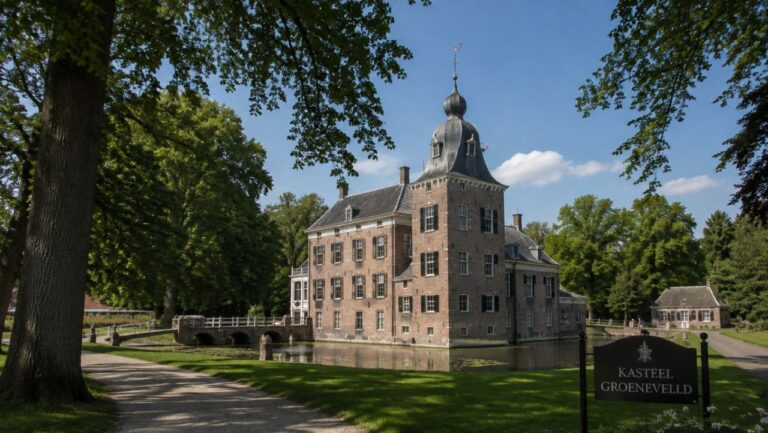
Kasteel Drakensteyn, the octagonal moated castle at the edge of the village, was built between 1640 and 1643 and bought by the then-Princess Beatrix in 1959. She returned to live there in 2014 after her abdication. Because it is a private royal residence, you cannot go inside or onto the grounds — this trips up a lot of visitors. You can see it clearly from the public footpath through the woods, and the walk out to it is lovely.
Amersfoort and Zeist
Amersfoort is four miles away and is the picture-postcard medieval city in this hand: an intact old center, the Koppelpoort water gate, canals, and Mondrian’s birthplace. It was named European City of the Year in 2023. Zeist, with its baroque Slot Zeist castle, is a twenty-minute drive south.
Cycling Around Soest
The Dutch numbered-junction system makes cycling here absurdly easy: you follow small numbered signs from one junction to the next rather than reading a map. There is a signed loop, “Cycle route around natural Soest,” of roughly 26 miles and about three hours, that strings together nearly everything on this page — Soestdijk Palace, Drakensteyn, the Baarnsche Bos woodland, Lage Vuursche, the Soester Dunes, the old air base and the Military Museum.
You do not need to be a serious cyclist. It is flat by any standard except Dutch, and there are pancakes at the halfway point. Several local accommodations rent regular and electric bikes; see our guide to a cycling holiday in the Netherlands for how the junction network works.
Why Soest Works as a Base
This is the practical argument, and it is the reason this small town matters more than its size suggests. From Soest:
| Destination | By car | By train or bus |
|---|---|---|
| Amersfoort | 4 miles / 12 min | Bus 70, 13 min, every 20 min |
| Utrecht | 12 miles / 21 min | Sprinter, about 20 min |
| Amsterdam Centraal | 27 miles / 38 min | About 1 hour, one change |
| Schiphol Airport | 29 miles / 42 min | About 1 hr 25 min |
| Rotterdam | 48 miles / 1 hr | About 1 hr |
| The Hague | 51 miles / 1 hr 5 min | About 1 hr |
| Arnhem | 37 miles / 52 min | About 1 hr |
| Keukenhof gardens | 39 miles / 1 hr 6 min | About 2 hr 15 min |
| Zaanse Schans | 34 miles / 41 min | About 1 hr 30 min |
| Kinderdijk | 47 miles / 1 hr | About 2 hr 10 min |
| Giethoorn | 66 miles / 1 hr 22 min | About 2 hr 45 min |
Five major cities inside an hour. The tulip gardens, the windmill villages and the canal village all reachable and back in a day. That is not true of very many places, and it is the whole reason this site is called Center of Holland. We make the full case in our guide to using a central Netherlands travel base and to building a Netherlands itinerary without changing hotels.
Getting to Soest
Soest sits on the local Utrecht–Baarn railway line, served by Sprinter trains twice an hour. There are three stations in town — Soest Zuid, Soest and Soestdijk — and Soest Zuid is the practical one for the southern, wooded side of town. At Baarn, one stop north, you connect to the Intercity network for Amsterdam and Amersfoort.
Bus 70 runs roughly every twenty minutes between Amersfoort, Soest and Hilversum. From Schiphol, the simplest route is a train to Utrecht Centraal and a Sprinter from there; our guide to traveling from Amsterdam Airport Schiphol covers ticketing and the OVpay system.
If you are driving, Soest is just off the A28 near Amersfoort. Parking in town is straightforward and mostly free — a genuine relief after Amsterdam.
Where to Stay in Soest
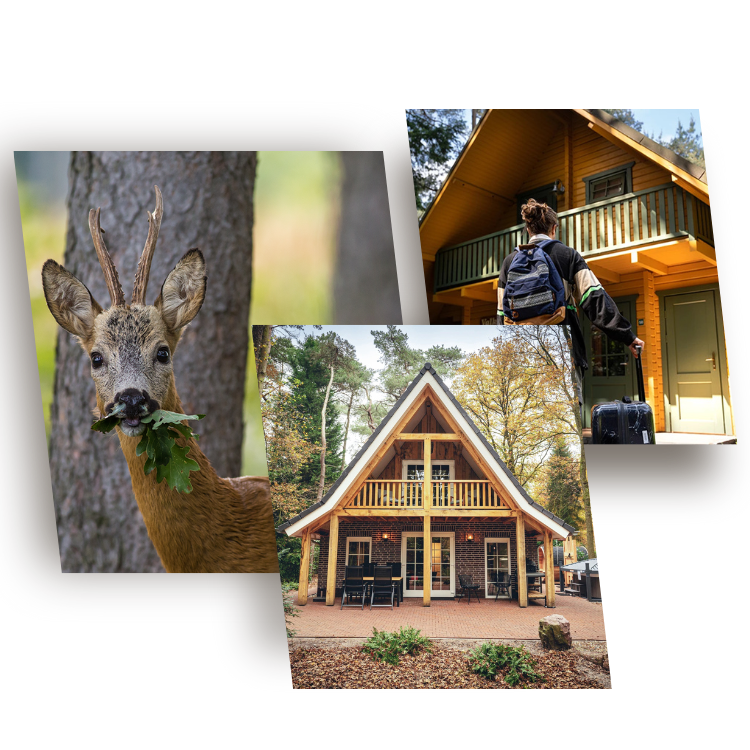
Soest has no large hotels, which is part of its charm. What it has instead is holiday accommodation set directly against the dunes and forest. Bungalowpark ‘t Eekhoornnest on Birkstraat has been operating since 1938 and has been run by the same family since 1963 — 42 cottages, bungalows and villas rather than a resort, with the woods and the Soester Dunes starting at the property line and De Paardenkamp a short walk down the same street.
Accommodations run from two-person cottages up to ten-person Scandinavian-style bungalows and a country house with private wellness. There is a Finnish kelo sauna looking out over the dunes, two playgrounds, a summer children’s program, and bike rental — regular and electric — through reception, which is the single most useful thing on the list given the cycling route above. Browse the available holiday homes in the Center of Holland.
A Suggested Two Days in Soest
Day one, on foot and by bike. Morning at De Paardenkamp, then walk into the Lange Duinen. Lunch in town or at the Thursday market. Afternoon at the Military Museum, then the old air base next door if the runway is open. Evening at Cabrio if something is playing.
Day two, the royal loop. Cycle or drive north to Soestdijk Palace, on through the Baarnsche Bos to Lage Vuursche for pancakes, past Drakensteyn on the forest path, and back over the dunes. Finish in Amersfoort’s old center for dinner.
Then spend the rest of the week going wherever you like — and coming back to the same bed each night. That is the trick this corner of the Netherlands does better than anywhere else.