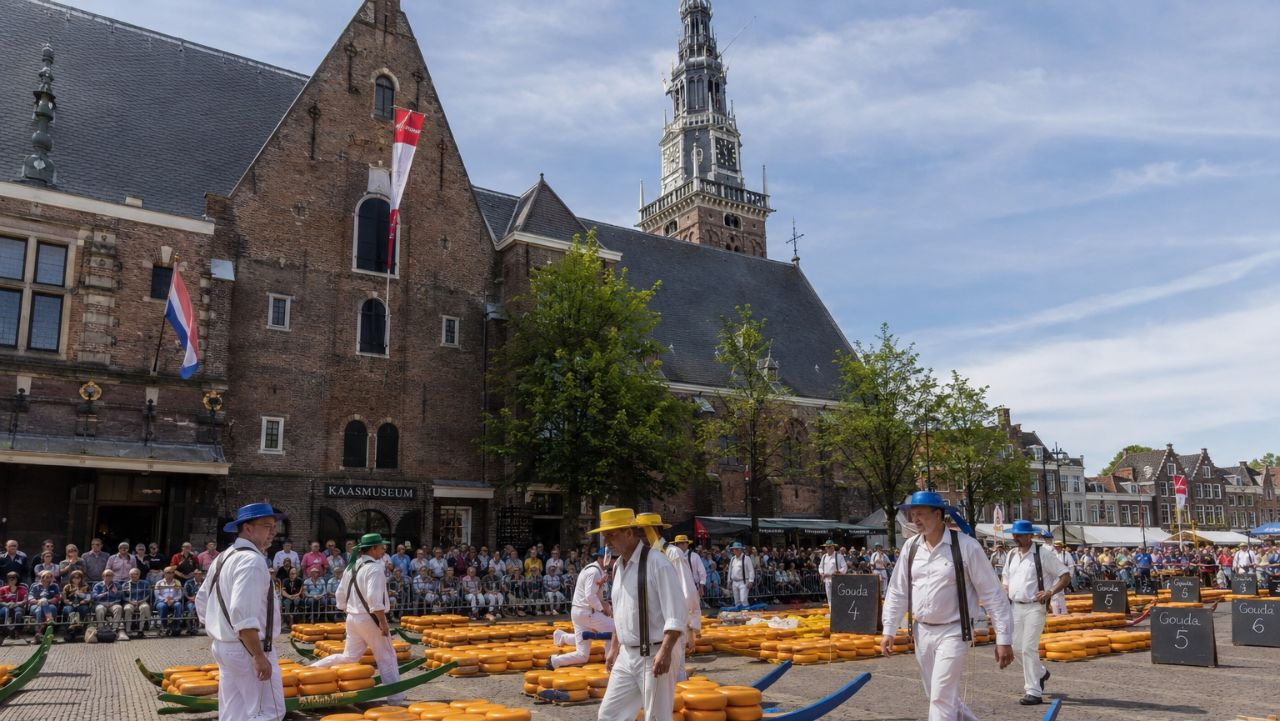
Four teams of men in white uniforms and colored straw hats, running, and they really are running, across a medieval square with 300 pounds of cheese slung between them on a wooden barrow. A bell rings at ten sharp. Buyers slap hands with sellers until a price is agreed. It has worked this way since the seventeenth century, and it still works this way now.
The Alkmaar Cheese Market is the most theatrical thing in the Dutch tourist calendar and, unusually, it costs nothing to watch. Here is everything you need to plan around it.
When Is the Alkmaar Cheese Market? Every 2026 Date
The rule: every Friday from the last Friday in March to the last Friday in September, 10:00 to 13:00, on the Waagplein.
Every 2026 market Friday:
- March: 27
- April: 3, 10, 17, 24
- May: 1, 8, 15, 22, 29
- June: 5, 12, 19, 26
- July: 3, 10, 17, 24, 31
- August: 7, 14, 21, 28
- September: 4, 11, 18, 25
Evening markets: Tuesdays from 19:00 to 21:00 during July and August. In 2026 that is July 7, 14, 21 and 28, and August 4, 11, 18 and 25. These are smaller and considerably less crowded than the Friday markets, and the low evening light on the Waag building is far better for photographs. If your schedule allows it, take the Tuesday.
Children’s cheese market: July and August, 10:30 to 11:00, with children doing the carrying. Exactly as charming as it sounds.
Planning for 2027? The dates are not yet published. Applying the market’s own rule would put the 2027 season between Friday March 26 and Friday September 24, but treat that as an inference rather than a confirmed schedule and check closer to the time.
One live caution: the market can be shortened in extreme heat. The Friday, August 14, 2026 market ran from 10:00 to 11:30 with a revised program because of temperatures. If you are visiting during a hot spell, check the official site on the morning itself.
What Actually Happens, Hour by Hour
The performance you watch at ten is the last act of a morning that started before dawn.
- 07:00: trucks roll onto the Waagplein and the setters begin laying out the cheese. Roughly 2,400 cheeses, about 30,000 kilograms, arranged in long rows across the square.
- 09:30: the cheese carriers must be at the Waag. Anyone arriving late is fined by the guild.
- 09:45: the kaasvader, the “cheese father,” takes the roll call, announces the day’s tonnage and assigns each team its position.
- 10:00: the kaasbel, the cheese bell, rings precisely on the hour and the market opens.
- Inspectors bore samples from the wheels and judge them on smell, texture and the distribution of holes. Prices are settled by handjeklap, a rapid, rhythmic slapping of hands between buyer and seller, and sealed with a handshake.
- Sold cheese is loaded onto berries, the wooden barrows, and carried at a distinctive bouncing half-run to the Waag scale, where the tasman sets the weights.
- 12:30: the last cheese leaves the square and the café terraces fill up.
The Guild and the Colored Hats
The carriers belong to four vemen, or companies, identified by color: red, green, blue and yellow. The color appears on their straw hats, their bow ties and their barrow. Each veem consists of six carriers and one tasman. The kaasvader leads all four and is easy to spot: orange hat, and a staff.
Three of the four teams work each market while the fourth covers gaps. A dice roll before the season decides who gets first pick of position, and it rotates weekly from there. These are not actors. It is a guild, with rules, and it has been running for a very long time.
Is the Alkmaar Cheese Market Free?
Yes, completely. There is no admission charge, no ticket and no barrier. The Waagplein is a public square.
There is also no paid grandstand or reserved seating, despite what you may read elsewhere. Neither the market’s organizers nor the city tourist board offers ticketed seating. Café terraces around the square have tables, but they are first come first served and they fill early.
How Early Should You Arrive?
The setters finish laying out the cheese by 09:30 and the bell rings at 10:00 exactly. Arrive before 09:30 and you get two things: a clear position along the rope, and the chance to watch the rows of cheese being set out on an empty square, which is a better photograph than the crowd scene at ten.
Arrive at 10:00 and you will be standing three deep behind other people’s phones. The market runs until 13:00, and the crowd thins noticeably after about 11:30. If you cannot get there early, going late is better than going on time.
Facilities on the square include wheelchair access, a hearing loop, a commentator, accessible parking and public toilets.
How Old Is This, Really?
Older than most countries. Alkmaar was granted the right to hold a weekly market in 1365, and cheese has been weighed on this square ever since. The Waag, the weigh house that dominates the Waagplein, began life in the fourteenth century as a chapel, and was converted to weighing cheese in 1582 when the city’s trade outgrew its faith.
The tower carries a carillon, and on the hour a small mechanical procession of jousting knights and a trumpeter emerges and circles. Look up at ten, twelve or one and you get a second show for free.
Alkmaar’s other claim is a piece of Dutch national mythology. In 1573 the city withstood a seven-week Spanish siege and forced the Duke of Alba’s army to withdraw, the first Spanish defeat of the Eighty Years’ War. The phrase “Van Alkmaar begint de victorie,” victory begins at Alkmaar, entered the language and has stayed there for four hundred and fifty years. October 8 is still celebrated in the city.
What Cheese Is It, and Can You Buy Some?
The wheels on the square are mostly Gouda-style cheese: the large, round, wax-coated kind that accounts for the majority of Dutch production, despite the name belonging to a city sixty miles away. Some smaller Edam-style rounds appear as well. The cheese changing hands is real commercial stock, not props.
You cannot buy from the market rows themselves, since that trade is between wholesalers, but stalls and shops around the square sell by the wedge, and this is a good place to learn what the Dutch aging labels mean:
- Jong: young, four weeks. Mild and rubbery.
- Jong belegen: around two months. The everyday sandwich cheese.
- Belegen: four months. Firmer, nuttier.
- Oud: a year or more. Hard, crystalline, sharp. This is the one to take home.
- Overjarig: over a year, sometimes several. Intense, crumbly and excellent with mustard.
Vacuum-sealed wedges of aged cheese travel well and are permitted into the United States, since hard cheese is allowed; soft and fresh cheeses are not. Buy oud or overjarig and it will survive the flight in a checked bag without complaint.
Getting to Alkmaar
From Amsterdam Centraal, a second-class single costs around €10.00 and the journey takes roughly 35 minutes. From Alkmaar station it is about a 15-minute walk to the Waagplein, following signs shaped like blocks of cheese.
Working backward: to be on the square by 09:30 you want a train leaving Amsterdam Centraal around 08:30. That is an early start but an easy one, and it puts you back in Amsterdam by early afternoon.
Alkmaar has city-center parking garages with live space indicators if you are driving, though on a market Friday the train is genuinely the better option. See our guide to day trips from Amsterdam by train for how Dutch rail ticketing and OVpay work.
The Cheese Museum in the Waag
The Hollands Kaasmuseum occupies the upper floors of the Waag building, the weigh house the whole market revolves around, at Waagplein 2. It covers the history of Dutch cheese-making, the guild, and the trade that made this region rich.
Admission is €7.00 for adults and €3.00 for children 4 to 12, free with a Museumkaart. Opening hours vary considerably by day and season, so check their site before you plan around it. It is open year-round, which makes it the obvious substitute if you arrive in Alkmaar out of season.
The Other Dutch Cheese Markets
Alkmaar is the biggest and the most theatrical, but it is not the only one. Two are on different days of the week, so with a little planning you can see more than one.
| Market | Day | 2026 season | Time |
|---|---|---|---|
| Alkmaar | Friday | March 27 to September 25 | 10:00 to 13:00 |
| Gouda | Thursday | April 2 to August 27 (no market May 14, Ascension) | 10:00 to 12:30 |
| Edam | Wednesday | July 1, 8, 15, 22, 29 and August 5, 12, 19 | 10:30 to 12:30 |
| Woerden | Saturday | May to August | Check locally |
Edam also holds a one-off evening market on Saturday, August 8, 2026, from 20:30 to 22:00.
Alkmaar or Gouda?
Alkmaar is bigger, busier and the full theatrical production: four guild teams, the running carriers, 2,400 cheeses. It is the one to see if you are only seeing one.
Gouda is smaller and more relaxed, set on a beautiful square in front of one of the finest town halls in the country, and it runs on Thursdays, which means it fits a trip that already has Friday committed. If Alkmaar looks too crowded for your taste, Gouda is the better morning.
A note on Hoorn: its cheese market appears to have ended. The official website now redirects to a domain-sale page and no 2026 dates are published anywhere. Do not plan around it.
What Else to Do in Alkmaar
The market finishes at 13:00 and you will have half a day left in a very pleasant small city. Alkmaar’s historic center is compact and ringed by canals, with canal cruises and boat rental, good shopping and the Stedelijk Museum Alkmaar, which holds a well-known painting of a cheese carrier.
Alkmaar also sits well with a wider North Holland day. Zaanse Schans is between Alkmaar and Amsterdam, so market in the morning and windmills in the afternoon is an easy combination by train.
Visiting Out of Season
If you are in the Netherlands between October and March, the market is not running. The Cheese Museum in the Waag stays open year-round and is the obvious substitute, along with the canals, the museums and the polder cycling routes. Be aware that no winter cheese demonstration is held, whatever some websites imply.
Where to Stay
Most people visit Alkmaar as a day trip rather than staying overnight, and the Friday timing makes it an easy morning from anywhere with a rail connection.
From a central base, Alkmaar is comfortably reachable for a 10:00 market and you are back the same afternoon, as is Amsterdam, Utrecht, Rotterdam and The Hague on the other days of the week. Bungalowpark ‘t Eekhoornnest in Soest, 42 cottages and bungalows at the edge of the Soester Dunes and family-run since 1963, sits in the middle of that map. Browse the available holiday homes in the Center of Holland.