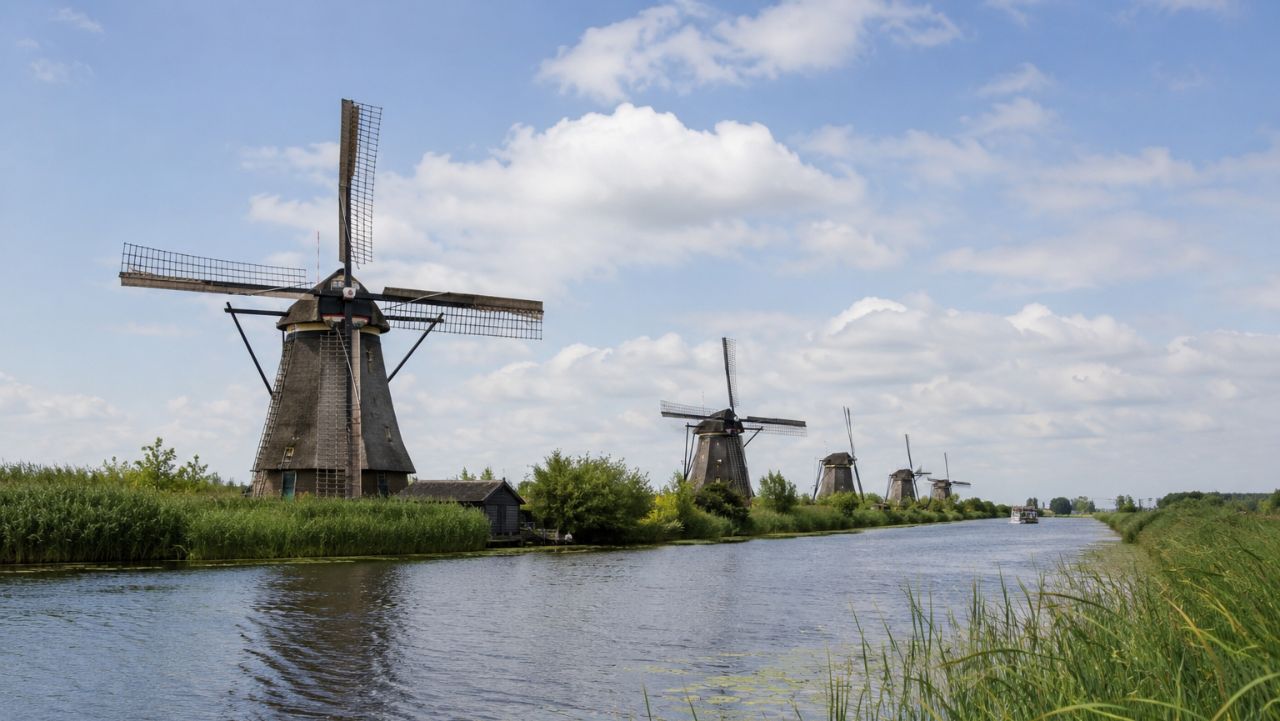
Nineteen windmills standing in a row along a polder canal, their sails turning against a huge Dutch sky. Kinderdijk is the image most people carry of the Netherlands before they ever arrive, and unlike a lot of postcard places, it does not disappoint when you get there.
It is also the Dutch attraction where the practical details changed most recently and most sharply. In March 2026 the parking rules were rewritten entirely, and in October 2025 the famous Rotterdam waterbus route was replaced by something that only runs on weekends. A lot of guides online are now wrong. Here is what is actually true.
What Kinderdijk Actually Is
Kinderdijk is not a village built for tourists. It is a working piece of water engineering that has been quietly doing its job for nearly three centuries.
The land here — the Alblasserwaard polder — sits below sea level and has been fighting water since the Middle Ages. The mills you see were built in 1738 and 1740, in two groups: the Nederwaard mills and the Overwaard mills, on either side of the canal. Their job was to lift water out of the polder and into a reservoir, from which it could be released into the river. Nineteen of them survive in place, which is the largest concentration of old windmills anywhere in the Netherlands.
There are three types standing here: eight round brick ground-sailers, ten thatched octagonal smock mills, and one hollow post mill. UNESCO inscribed the site in 1997 as the “Mill Network at Kinderdijk-Elshout.”
Several of the mills are still lived in. When you walk the dike, you are walking past people’s front doors.
Where the Name Comes From
Kinderdijk means “child dike,” and the story attached to it is one of the oldest in Dutch folklore. After the St Elizabeth’s Flood of 1421, which drowned much of this region, villagers went out to inspect the dike and saw a wooden cradle bobbing on the floodwater with a cat jumping from side to side to keep it balanced. Inside, dry and asleep, was a baby.
It is almost certainly not true. It is also exactly the kind of story a country produces when it has spent a thousand years arguing with the sea, and every Dutch schoolchild knows it.
How the Mills Actually Work
This is what separates Kinderdijk from a windmill you photograph and forget. These are not grinding mills. Each one drives a large scoop wheel or an Archimedes screw that lifts water — only about four feet at a time, which is why they work in stages. The Nederwaard mills lift water from the polder into a low reservoir; the Overwaard mills lift it again. From the reservoir it can be released into the river Lek when the tide allows.
Nineteen mills, working in relay, kept an entire region habitable for two hundred years. Diesel and then electric pumping stations took over in the twentieth century, but the mills are maintained in working order and are still capable of doing the job if they are needed. Several are turned regularly.
The Wisboom pumping station, included in your ticket, is the machine that replaced them, and seeing the two side by side is the whole point of the visit.
Tickets and What They Include
2026 prices from the official site:
- Adults: €21.00
- Children 4–12: €9.00
- Children 0–3: free
- Booking online takes 10% off automatically
- Groups of 15 or more are arranged directly with the site
The ticket covers the two museum mills you can go inside, the boat tour along the canal, the Wisboom pumping station, the bird theater, the film and the exhibition in the secondary pumping station, and the visitor center. An audio-guide app is included.
Opening hours: March 6 to November 1, 09:00–17:30. November 2 to December 31, 10:30–16:00. Closed December 25.
Can You See Kinderdijk for Free?
Yes — partly, and this is worth knowing. The public foot and cycle path along the dike is open all year and costs nothing. You can walk the length of the mill field, photograph all nineteen mills from every angle, and leave without paying a cent.
What you pay for is going inside: the two museum mills furnished as they were lived in, the boat, the pumping station and the exhibitions. If your interest is photographs and the landscape, the free path genuinely is enough. If you want to understand how the things work and see how a miller’s family lived in one, buy the ticket.
Parking Changed in March 2026 — Read This Before You Drive
This is the single most important practical update and most articles still have it wrong.
You can no longer park in Kinderdijk village. Parking there without a permit between 09:00 and 18:00 carries a €100 fine plus administrative costs, and vehicles can be towed.
All visitors arriving by car must now use the Transferium Alblasserdam “d’Ouwe Kabel,” Kabelbaan 1, 2952 BS Alblasserdam, which opened on March 11, 2026. It has around 250 spaces, including accessible bays, camper spaces and coach parking. A shuttle bus runs daily between the transferium and the windmill area, with the first departure at 08:45 and the last shuttle back from Kinderdijk at 17:45. Rental bikes are also available there if you would rather ride the last stretch.
Campers cannot park at Kinderdijk at all. There is a daytime facility at Lekdijk 432A in Nieuw-Lekkerland, open until 20:00, with no overnight parking.
Getting There Without a Car
From Rotterdam by water — the best way
Arriving by boat is the right way to see this place, because you approach the mills from the water they were built to move. The former Waterbus line 21 was replaced in October 2025 by the “WaterShuttle.” It departs from Rotterdam Willemskade, takes about 30 minutes, and — this is the catch — runs only on Fridays, Saturdays and Sundays, several times a day.
Fares are €9.75 one way and €19.50 return; under-fours travel free and ages 4–11 pay half. A combined WaterShuttle-plus-entry ticket exists through their ticket shop.
Monday to Thursday you need the alternative: Waterbus line 20 to Ridderkerk (about 26 minutes), then the separately operated Driehoeksveer ferry across (about 10 minutes, €2.35, separate ticket). Or line 20 to Alblasserdam (about 19 minutes) and then ten minutes by bike — bikes travel free on board — or roughly an hour on foot.
From Rotterdam by bus
Qbuzz line 489 runs from Rotterdam Kralingse Zoom, on metro lines A, B and C, out through Ridderkerk and Alblasserdam to Kinderdijk and on to Nieuw-Lekkerland. It runs roughly every 30 minutes, more often at peak. This is the reliable weekday option.
From Amsterdam
There is no direct service, and anyone who tells you a precise door-to-door time is guessing. The route is: Intercity from Amsterdam Centraal to Rotterdam Centraal, then either the metro to Kralingse Zoom and bus 489, or — on a Friday, Saturday or Sunday — down to Willemskade for the WaterShuttle. Budget the better part of a day for the round trip. Our guide to day trips from Amsterdam by train covers the destinations that are genuinely easy by rail; Kinderdijk, honestly, is not one of them.
This is one of the arguments for basing yourself more centrally. From the center of the Netherlands, Kinderdijk is about an hour by car — as is Rotterdam, The Hague, Utrecht and Amsterdam.
Kinderdijk vs Zaanse Schans: Which Should You Choose?
This is the real question most visitors are asking, and the honest answer is that they are not the same kind of place at all.
Zaanse Schans is a heritage village near Amsterdam. Its mills are working industrial mills — sawing wood, grinding pigment and spices — and most of them were moved here from elsewhere in the Zaan region to be preserved. Around them sit green wooden houses, a cheese farm, a clog workshop, craft demonstrations and cafés. The village itself is open-access and free to walk through; you pay for individual mills and museums. It is about fifteen minutes from Amsterdam, which makes it the default half-day trip — and also means it can be very crowded.
Kinderdijk is a landscape. The mills are where they were built in 1738 and 1740, doing what they were built to do, strung along a canal through open polder with essentially nothing else there. There are no clog demonstrations and no cheese shop. What there is instead is a mile of water, sky and turning sails.
Choose Zaanse Schans if you have one day, you are based in Amsterdam, you are traveling with children who will enjoy the craft demonstrations, or you want the full range of Dutch things in one stop.
Choose Kinderdijk if you care about the engineering and the history, you want photographs without a souvenir stand in the frame, you are coming from Rotterdam, or you have been to Zaanse Schans and found it busy.
If you have time for both, do both — they are 45 miles apart and they tell different halves of the same story. And if you want a third, quieter option, there are working windmills all over the country, including De Windhond in Soest, where you can usually have the miller to yourself.
Making the Most of a Visit
Time. Give it two to three hours if you are taking the ticket, boat and museum mills. An hour is enough for the free dike walk.
Light. The mills run roughly northeast to southwest along the canal, so early morning and the last hour before sunset both give you low light down the line of them — the shot everybody wants. Midday in summer is flat light and the largest crowds.
Weather. There is no shelter out on the dike. Wind coming across open polder in October is a serious proposition. Dress for more than the forecast says.
Bikes. The site is long and linear, and cycling it is both faster and more fun than walking. Rentals are available at the transferium. If you want to build a whole day around it, see our guide to a cycling holiday in the Netherlands.
Combining it. Kinderdijk pairs naturally with Rotterdam — modern architecture in the morning, 18th-century water engineering in the afternoon — or with Gouda, half an hour away.
When to Visit
Spring, April and May. The best all-round window. Long light, active bird life in the reeds, and the site is busy but not overwhelmed. The polder is at its greenest.
Summer. Peak crowds, especially between 11:00 and 15:00 when the coach groups and river-cruise passengers arrive. Go early or late in the day and you get a substantially different experience on the same site.
Autumn. The connoisseur’s choice. Low light, dramatic skies, mist rising off the canal on cool mornings, and far fewer people. Dress properly — there is no shelter anywhere on the dike.
Winter. Reduced hours, from 10:30 to 16:00, and a bleak, beautiful landscape. In a hard frost the canal freezes and Dutch families come out to skate on it, which is a sight worth planning a trip around, though it happens less often than it used to.
Whenever you come, check whether the mills will be turning. They are set to sail on specific days and during particular events, and a Kinderdijk with nineteen still mills is a different photograph from a Kinderdijk with nineteen turning ones.
If You Are Arriving on a River Cruise
A large share of American visitors reach Kinderdijk from a Rhine cruise, and the ships moor close to the site. Two things are worth knowing.
First, the guided excursion typically allows around 90 minutes, which is enough for the visitor center and one museum mill but not for walking the full length of the dike. If photographs matter to you, skip part of the guided commentary and walk further out — the best views are beyond where the groups usually turn around.
Second, cruise arrivals cluster, so the site can go from quiet to crowded in ten minutes. If you have any choice in timing, take the earliest slot offered.
What to Combine It With
Rotterdam is the natural pairing and only about half an hour away. The contrast is the appeal: the most aggressively modern skyline in Europe in the morning, eighteenth-century water engineering in the afternoon. Both are answers to the same question about living below sea level.
Gouda is roughly thirty minutes north, with its cheese market on Thursday mornings from April to August and one of the finest town halls in the country.
Dordrecht, the oldest city in Holland, is close by and much less visited than it deserves; from there the Biesbosch national park is a short hop.
Where to Stay
Kinderdijk itself is a hamlet with no visitor accommodation to speak of. Most people come from Rotterdam, or from a central base.
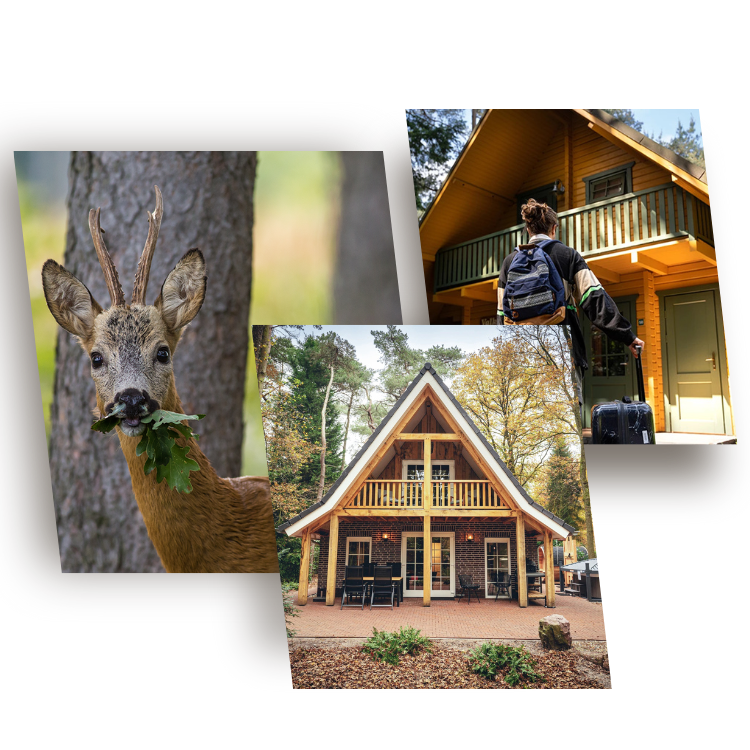
Staying in the middle of the country puts Kinderdijk, Amsterdam, Utrecht, Rotterdam and The Hague all within roughly an hour by car, without changing hotels once. Bungalowpark ‘t Eekhoornnest in Soest — 42 cottages and bungalows against the Soester Dunes, family-run since 1963 — is about an hour’s drive from the windmills. Browse the available holiday homes in the Center of Holland.