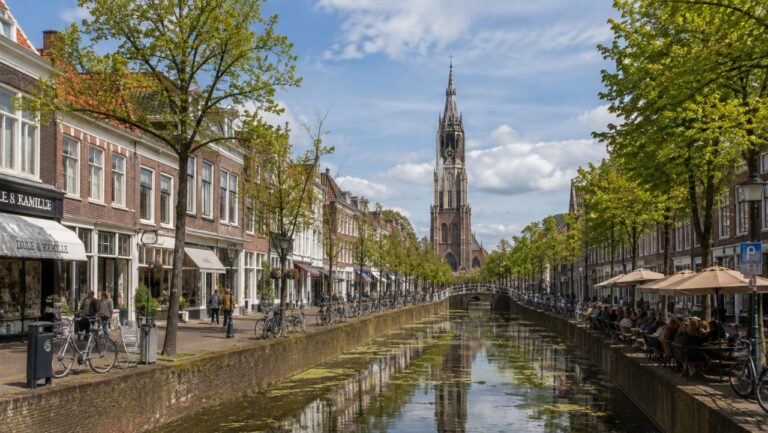
Delft is the Netherlands that people picture and then assume no longer exists — a small canal city with leaning gabled houses, arched bridges, a market square framed by a Gothic church and a Renaissance town hall, and a pottery tradition that has been running since 1653. It is compact enough to walk end to end in twenty minutes and rich enough to fill two days.
It is also, right now, a city where several famous things are either closed or not where visitors expect them to be. This guide is written to get that straight before you buy a train ticket.
Read This First: Three Things That Trip Visitors Up
1. Girl with a Pearl Earring is not in Delft. Vermeer lived, worked and died here, but the painting hangs in the Mauritshuis in The Hague, about fifteen minutes away by train. There are no original Vermeers in Delft at all.
2. Museum Prinsenhof is closed. The building where William of Orange was assassinated in 1584 — the one with the bullet holes in the stairwell wall — has been shut for renovation since January 2025. The museum’s own published reopening window is “2027 to 2031,” which is unusually vague. Parts of the collection are on show at Royal Delft, at the Kabeldistrict in Delft and at the Stedelijk Museum Breda in the meantime. Check the museum’s site before you plan a day around it.
3. The Mauritshuis has closures in 2026. If you were planning to pair Delft with the Girl in The Hague, note that the painting is off display from August 15 to October 4, 2026, and the Mauritshuis itself closes for maintenance from August 24 to September 20, 2026. Check before you go.
None of this ruins Delft. It just changes what you plan.
Royal Delft: The Last of the Original Potteries
De Koninklijke Porceleyne Fles at Rotterdamseweg 196 is the only surviving 17th-century Delftware factory, founded in 1653. At its height there were more than thirty potteries in the city; this is the one that lasted. Painters still work on site, applying designs by hand, and you can watch them do it.
- Admission: adults €17.50, ages 13–18 €10.00, students with ID €11.50, under-sixes free. Ages 7–12 are free through August 30, 2026 and €7.50 from August 31. Museumkaart holders enter free.
- Hours: daily 09:30–17:00, extended to 09:00–17:00 from April 1 to May 15. Last entry 16:00. Closed December 25, 26 and January 1.
- An audio tour in eight languages is included. The factory tour is a separate guided booking.
- Wheelchair accessible, though not for electric wheelchairs.
How to Buy Real Delft Blue
The souvenir shops around the Markt sell a great deal of blue-and-white pottery that was transfer-printed, often not in the Netherlands. Genuine hand-painted Delftware carries a factory mark and the painter’s initials on the base, and it costs what hand-painted work costs. Buy from Royal Delft itself or from one of the working painting studios in the city if you want the real thing. If you want a €12 tile as a keepsake, buy the tile — just know which you are buying.
The Nieuwe Kerk, the Tower and the Royal Crypt
The Nieuwe Kerk on the Markt holds the mausoleum of William of Orange, the leader of the Dutch revolt against Spain and the founding father of the Netherlands, who was murdered in Delft in 1584. The monument itself is magnificent and openly visible.
Beneath it lies the royal crypt, where nearly every member of the House of Orange-Nassau since William has been interred — most recently Prince Claus in 2002 and Queen Juliana and Prince Bernhard in 2004. The crypt is not open to the public, and the church is candid about it: what the tombs actually look like remains, in their words, generally unknown. You are standing above one of the most private spaces in the country.
The tower is 108.75 meters — 357 feet — and the second tallest church tower in the Netherlands. You can climb it. The view runs from Rotterdam to The Hague and, on a clear day, to the sea.
The medieval Oude Kerk, a few hundred yards away, leans visibly out of true and holds Vermeer’s grave, along with those of the microscopist Antonie van Leeuwenhoek and the naval hero Piet Hein.
- Both churches: €10.00 adults, €4.75 children 6–11, €8.00 students under 25. Under-fives free to the churches.
- Tower: €7.50 adults, €4.25 children 6–11. Under-sixes are not admitted; ages 6 to 16 need an accompanying adult.
- Combination ticket, both churches plus tower: €15.00.
- Hours: February–October daily 10:00–17:00. November–January, Monday–Friday 11:00–16:00 and Saturday 10:00–17:00. The tower closes an hour earlier than the churches.
- Sundays are reserved for services. The tower may close in high wind. No backpacks or umbrellas on the climb; assistance dogs only.
Vermeer Centrum Delft
Vermeer was born in Delft, spent his entire working life here, served as headman of the Guild of St Luke, and was buried in the Oude Kerk. He left roughly 35 paintings and none of them are in his hometown.
The Vermeer Centrum at Voldersgracht 21 — on the site of the old painters’ guild — addresses this directly. It shows full-size, high-quality reproductions of Vermeer’s complete body of work across four floors, so you can see the entire oeuvre in one room, which you cannot do anywhere on earth with the originals. There is a section on his studio and technique, including the camera obscura question, a display on the Rijksmuseum’s restoration of Woman Reading a Letter in Blue, and an ultra-high-resolution interactive table.
Be clear-eyed about what this is: reproductions, honestly presented. For understanding how Vermeer worked and seeing the arc of his output, it is excellent. For standing in front of an original, go to the Mauritshuis or the Rijksmuseum.
- Admission: adults €15.00, ages 13–18 €7.50, ages 7–12 €2.00, under-sevens free, Museumkaart €11.00. Audio tour included.
- Hours: daily 10:00–17:00.
The Markt, the Canals and the Markets
Delft’s Markt is one of the most photographed squares in the Netherlands: the Nieuwe Kerk at one end, the Renaissance Stadhuis at the other, cafés down both long sides. It is also a working market square.
- General market: Thursdays on the Markt and Brabantse Turfmarkt; Saturdays on Brabantse Turfmarkt and Burgwal.
- Flower market: every Thursday on the Brabantse Turfmarkt.
- Antiques, curiosities and books: every Saturday from April through October, on the Hippolytusbuurt beside the Oude Kerk. This is the good one.
For canals, walk the Oude Delft — the oldest canal in the city and arguably the prettiest street in the country — and cross at the little arched bridges for the classic view back along the water. The Oude Kerk tower framed at the end of a canal is the shot.
Canal Tours
Boat tours run from Koornmarkt 113, last about 50 minutes, and cost €14.00 for adults and €6.50 for children 4 to 16, with under-fours free. They operate April 1 through October 31, daily 11:00–18:00, with hourly departures. There is a live guide covering Vermeer, Delft Blue, Van Leeuwenhoek and the Dutch East India Company. Worth it — the city reads differently from water level.
Walking Vermeer’s Delft
You cannot see Vermeer’s paintings in Delft, but you can stand where he painted them, and that turns out to be surprisingly moving.
The View of Delft. Vermeer’s great cityscape, now in the Mauritshuis, was painted looking north across the Kolk harbor toward the Schiedam and Rotterdam gates. The gates are gone, but the vantage point survives, and there is a marker at the spot. The light on the water still behaves the way he painted it.
The Little Street. Long argued over, the house in Het Straatje is now generally identified with a site on the Vlamingstraat. It is an ordinary residential street and there is nothing to buy there, which is rather the point.
Voldersgracht. Vermeer was born on this canal and the Guild of St Luke, which he twice headed, stood where the Vermeer Centrum is now.
Market Square and the Oude Kerk. He was baptized at the Nieuwe Kerk on the Markt and buried in the Oude Kerk, where a simple stone marks the family grave. He died in debt at 43, leaving eleven children.
The Delft Thunderclap: Why the City Looks Like This
On October 12, 1654, the national gunpowder magazine on the north side of Delft exploded. Roughly 90,000 pounds of powder went up at once. It flattened a large part of the city, killed hundreds, and was heard on the island of Texel, more than seventy miles away.
Among the dead was Carel Fabritius, Rembrandt’s most gifted pupil and, by most accounts, the man who taught Vermeer. Almost all of his work was destroyed with him; barely a dozen paintings survive, including The Goldfinch, painted the year he died.
The open, unusually spacious feel of the northern part of the old center is a direct result. The blast cleared it, and the ground was never rebuilt the same way. When you stand on the Doelenplein you are standing in the crater.
Where to Eat and What to Do in the Evening
The Markt is lined with terraces, and on a warm evening with the Nieuwe Kerk floodlit it is hard to beat, though you pay for the address. Locals tend to drift to the Beestenmarkt, a tree-shaded square a few minutes south, which has the better atmosphere and the more reasonable prices.
For a genuine Dutch bruin café — brown café, so named for the tobacco-stained wood — look along the Oude Delft and the small streets running off it. Order a bittergarnituur, the standard plate of fried snacks that arrives with beer, and you have the local evening exactly right. Our guide to traditional Dutch desserts covers what to finish with.
Delft is also a university town — TU Delft is the country’s leading technical university — which means a young population, good cheap food, and a city that stays awake after the day-trippers have gone. That last point is the argument for an overnight stay: at seven in the evening the Markt belongs to the people who live here.
Best Photo Spots in Delft
- The Oude Delft canal, looking south with the leaning Oude Kerk tower framed at the end. The classic shot, and best in the morning.
- The arched bridge at Hippolytusbuurt, especially on a Saturday when the antiques market is out.
- The Markt from the Nieuwe Kerk steps, looking down the length of the square to the Stadhuis.
- From the top of the Nieuwe Kerk tower — the red-tiled roofs of the old city with Rotterdam’s skyline behind.
- The Kolk, for Vermeer’s own view, at the end of the afternoon.
Delft with Kids
Delft is a walking-and-looking city, which is a mixed proposition with children. What works: the canal boat tour, at 50 minutes and €6.50 for ages 4 to 16, is short enough and interesting enough. Royal Delft lets children watch painters at work and ages 7 to 12 are free through August 30, 2026. The tower climb is a hit with anyone old enough to manage it, though under-sixes are not admitted.
What does not work: the Vermeer Centrum is aimed squarely at adults. And Delft has no park of any size in the center, so plan your breaks around a terrace on the Beestenmarkt rather than a playground.
Getting to Delft
Delft’s station is a short walk from the old center.
- From Amsterdam Centraal: around €17.30 for a second-class single.
- From Rotterdam Centraal: around €4.40.
- From The Hague Centraal: around €3.30.
That Hague fare tells you everything about combining the two. See our guide to day trips from Amsterdam by train for how the Dutch rail network and OVpay work, and our guide to getting around in Holland for tickets and passes.
Can You Do Delft and The Hague in One Day?
Yes, comfortably, and it is one of the best combinations in the country. They are minutes apart and they complement each other: Delft is small, old and intimate; The Hague is grand, governmental and holds the art.
A workable plan: start in Delft in the morning when the Markt is quiet, do the Nieuwe Kerk and the tower, walk the Oude Delft, take an early lunch on the square. Train to The Hague after lunch for the Mauritshuis — check the 2026 closures noted above — and finish with an hour at Scheveningen beach if the weather is behaving. Reverse it if you want Delft in the evening light, which is the better photograph.
Add Rotterdam and you have three completely different cities within twenty minutes of each other.
How Long Do You Need in Delft?
Half a day gets you the Markt, one church and a walk along the canals. It is enough to see why people love the place.
A full day adds Royal Delft — which is a fifteen-minute walk or short bus ride from the center, so it needs its own slot — plus the tower climb and a canal tour.
Two days lets you add the Vermeer Centrum, the Saturday antiques market and time simply sitting on the square, which is arguably the main activity.
Where to Stay
Delft has hotels, and staying overnight in a small canal city after the day visitors leave is genuinely lovely. But Delft is also a place most people see as part of a wider trip, and it sits within easy reach of a central base.
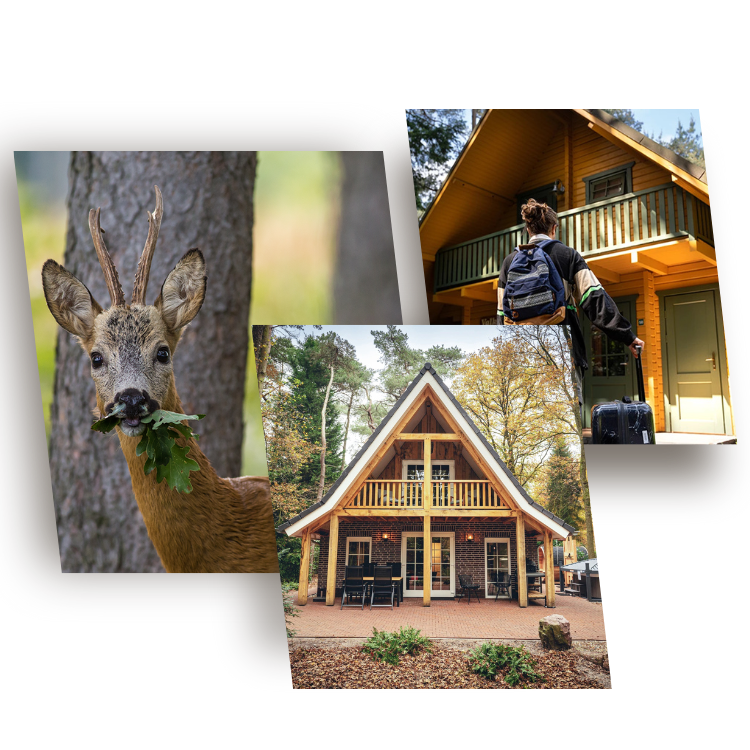
From the middle of the country, Delft is about an hour by road or rail — as are Amsterdam, Rotterdam, Utrecht and The Hague. Bungalowpark ‘t Eekhoornnest in Soest, family-run since 1963 with 42 cottages and bungalows backing onto the Soester Dunes, is a little over an hour from Delft’s market square. See the available holiday homes in the Center of Holland, or read our guide to a central Netherlands travel base.